
Order Buffer Solutions
Overview and Purpose
The AutoStore Order Buffer enables a dedicated smart buffer zone within the grid. It uses the cell content feature (content codes + updatecellandbincontent) to group all bins belonging to the same order/shipment together in one or a small number of cells. This delivers:
- Rapid access to complete buffered orders (minimal or zero digging when sequence requirements allow).
- AutoStore acting as an active sorting system.
- Independent buffer operation (separate from main inventory cells)
“Order” here means a shipment/delivery batch where all associated bins are consolidated and dispatched together. The buffer can coexist with standard inventory in the same grid, but this chapter focuses on the pure buffer use case for clarity.¨
Key Concepts
Cell States
- Empty cells (reserved buffer space for new orders).
- Empty-bin cells (active stacks + full reserve stacks).
- Order cells (all bins of one order grouped by content code)
Content Code Strategies
- Strategy A (WMS-managed mapping): Unique content code per cell/order. WMS tracks mapping internally. No dynamic
updatecellandbincontentneeded after initial assignment. - Strategy B (Dynamic codes): Fixed code for empty cells + per-order codes. WMS calls
updatecellandbincontentto reassign cells between empty/order/empty-bin states as needed. More flexible but requires careful WMS state management.
Managing Empty Bins (Density & Performance)
- To maintain the density of the system, it is recommended to avoid wasting storage space in the cells that store the empty bins. This can be controlled by using multiple content codes for the empty bins.
- Use one content code for the full stacks of empty bins that are not yet needed. This ensures that these cells are kept full of bins without wasting storage capacity. We don’t “split up” more stacks than we need to and end up with a lot of half full cells.
- Use another content code for the cells that contains the active empty bin stacks. These stacks will typically have a varying number of bins in them.
- The inbound process should request empty bins using the ‘active’ content code. The outbound process should return empty bins using the ‘active’ content code.
- The WMS will move cells between active/non-active according to the number of empty bins in the system (
updatecellandbincontent) - There should be multiple active stacks. (Too few may have a negative performance impact, but this is a trade-off between performance and density.)
Inserting Orders Into The Buffer
- New order arrives in WMS → assign one or more cells + content code(s) to the order.
- When inserting bins:
- Set the bin’s content code to the order’s code(s) (via insert-bin / insert-prepare-bin payload).
- AutoStore automatically routes/sorts the bin into the correct order cell(s).
- Optimizations:
- Sequence requirements → split order into sequenced sub-groups (one cell per sequence segment).
- Spare capacity periods → temporarily use extra cells, then consolidate into final sequenced cells (moves work off-peak but consumes extra robot capacity).
Outbound Process
Use standard picking flows:
- Task Interface or Bin Interface.
- No sequence requirements → digging eliminated (all bins in 1–few cells).
- Sequence requirements → limited digging may occur.
- After complete dispatch:
- Strategy A → update internal WMS mapping only.
- Strategy B → call
updatecellandbincontentto return cell(s) to empty-bin or empty-cell code.
- Required system configuration: Disable “Content Disallow Temporary Storage Outside Area” (allows temporary placement during digging).
System Configuration
The system setting Content Disallow Temporary Storage Outside Area shall be disabled in the Console. This allows digging process to temporarily place bins in other cells.
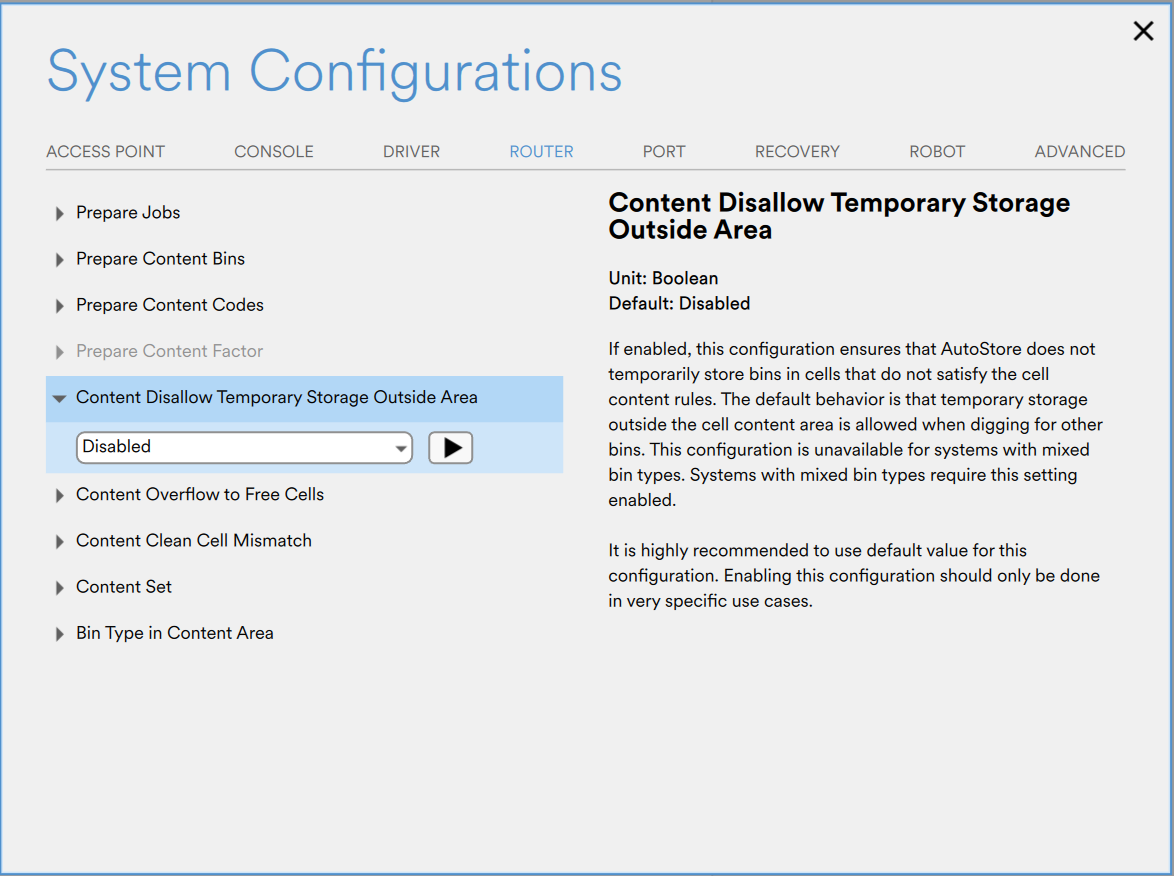
Disable "Content Disallow Temporary Storage Outside Area".
System Design Impacts
The system must be designed with some spare space:
- There must be empty cells available, allowing for new and ongoing inbound processes for orders in parallel.
- Important factors are for example how many orders that will be in inbound state in parallel, how many bins per order.
- The number of bins per order is typically not a multiple of full cells. We will lose some space in each ‘order cell’.
Updated about 2 months ago